
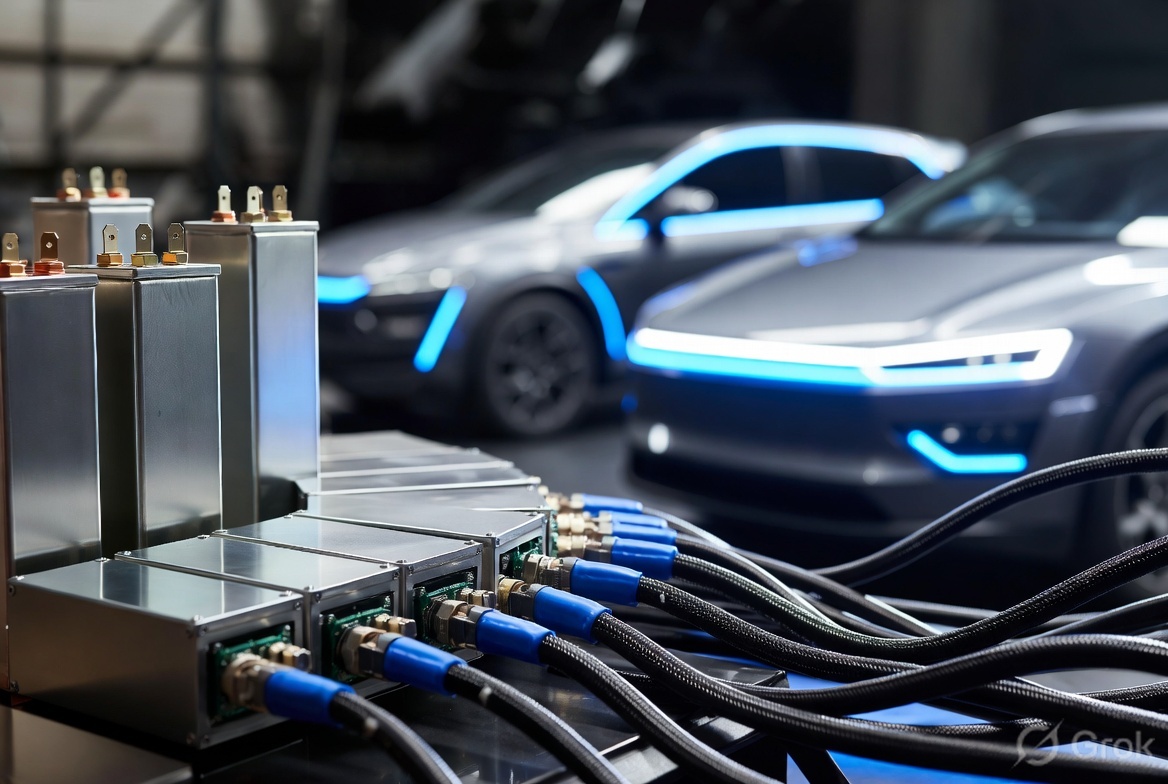
Automotive Ultracapacitor | Supercapacitor | Energy Storage | Regional Breakdown | April 2026 | Source: WGR
| $9.8B | 22.4% | $1.4B |
|---|---|---|
| Market Value by 2035 | CAGR (2025-2035) | Market Value in 2024 |
Automotive Ultracapacitor Market
Key Takeaways
-
Automotive Ultracapacitor Market is projected to reach USD 9.8 billion by 2035 at a 22.4% CAGR.
-
High-power density for regenerative braking and peak power buffering are the dominant structural growth drivers.
-
48V mild hybrid systems and fuel cell vehicle start-up power are gaining traction among automakers.
-
Maxwell Technologies (Tesla), Skeleton Technologies, Nippon Chemi-Con, Panasonic, and Ioxus lead competitive supply.
-
Asia-Pacific dominates manufacturing; Europe accelerates through 48V mild hybrid adoption.
The Automotive Ultracapacitor Market is projected to grow from USD 1.4 billion in 2024 to USD 9.8 billion by 2035 at a 22.4% CAGR, driven by the mass-market adoption of ultracapacitors across 48V mild hybrid and battery electric vehicle platforms, the expansion of high-power density energy storage into regenerative braking and peak power buffering, and the proliferation of ultracapacitor-lithium battery hybrid systems that directly improve acceleration and extend battery life.
Market Size and Forecast (2024-2035)
| Metric | 2024 Value | 2035 Projected Value / CAGR |
|---|---|---|
| Automotive Ultracapacitor Market | USD 1.4B | USD 9.8B | 22.4% CAGR |
Segment & Technology Breakdown
| Application | Segment | Primary Buyer | Key Driver |
|---|---|---|---|
| Regenerative Braking | 48V MHEV, HEV | Automakers | Fuel efficiency, brake wear reduction |
| Peak Power Buffering | BEV, FCEV | EV Manufacturers | Acceleration boost, battery protection |
| Engine Start-Stop | Start-Stop Systems | Tier-1 Suppliers | Battery strain reduction |
| Voltage Stabilization | All Electrified Vehicles | OEMs | Electronics protection, smooth power |
What Is Driving the Automotive Ultracapacitor Market Demand?
-
48V Mild Hybrid Growth: Ultracapacitors enable 48V MHEVs to capture regenerative braking energy efficiently, improving fuel economy by 15-25% at lower cost than full hybrids, with European automakers leading adoption.
-
Battery Load Reduction: Peak power events (acceleration, regenerative braking) stress lithium-ion batteries, with ultracapacitors reducing peak currents by 30-50%, extending battery cycle life by 20-40% and reducing thermal management requirements.
-
Cold-Cranking Performance: Ultracapacitors maintain cranking power at sub-zero temperatures where lithium-ion performance degrades, improving cold-weather reliability for start-stop systems and emergency vehicles.
-
Fast Charging Buffer: Ultracapacitors can absorb high-current pulses during fast charging, protecting batteries from voltage spikes and enabling higher charging acceptance rates for regenerative energy capture.
KEY INSIGHT
Automakers deploying ultracapacitor-battery hybrid systems report 20-30% improvement in regenerative braking energy capture and 3-5x cycle life improvement for batteries in start-stop applications, with 48V MHEV systems achieving 15-20% fuel economy gains at 30-40% lower cost than full hybrids.
Get the full data — free sample available:
→ Download Free Sample PDF: Automotive Ultracapacitor Market
Includes market sizing, segmentation methodology, and regional forecast tables.
Regional Market Breakdown
| Region | Maturity | Key Drivers | Outlook |
|---|---|---|---|
| Asia-Pacific | Dominant | HEV production, 48V adoption | Highest volume; China, Japan, Korea lead |
| Europe | High-Growth | 48V mild hybrid mandates, CO2 targets | Fastest-growing; Germany, France lead |
| North America | Growing | Pickup/SUV 48V systems | Steady; start-stop applications |
| Middle East & Africa | Emerging | Hot-climate reliability | Growing; cold-cranking less relevant |
| South America | Early | Flex-fuel vehicles | Moderate; niche applications |
Competitive Landscape
| Category | Key Players |
|---|---|
| Global Leaders | Maxwell Technologies (Tesla), Skeleton Technologies, Nippon Chemi-Con |
| Japanese/Korean | Panasonic, Murata, LS Mtron, Samwha |
| European | CAP-XX, Yunasko, Skeleton Technologies |
| Chinese | Jianghai Capacitor, Nantong Jianghai, Shenzhen Technology |
Outlook Through 2035
Ultracapacitor energy density improvement, 48V system standardization, and li-ion hybrid integration will define the automotive ultracapacitor market through 2035. Vendors investing in higher energy density cells (targeting 10-15 Wh/kg), lower equivalent series resistance (ESR), and automotive-grade reliability will capture the highest-margin OEM and tier-1 supplier contracts as ultracapacitors transition from niche application to standard EV component.
Access complete forecasts, segment analysis & competitive intelligence:
→ Purchase the Full Automotive Ultracapacitor Market Report (2025-2035)
*10-year forecasts | Segment & application analysis | Regional data | Competitive landscape | 350+ pages*
Keywords: Automotive Ultracapacitor | Supercapacitor | 48V Mild Hybrid | Regenerative Braking | Energy Storage | EV Ultracapacitor | Start-Stop System | Peak Power Buffer
© 2025 WiseGuy Reports (WGR) · All Rights Reserved · wiseguyreports.com
All market projections are forward-looking estimates sourced from WGR’s proprietary research reports and subject to revision.

